Tunisian Olive Oil: A Buyer’s Guide
Tunisia is the second largest olive oil producer in the world and has one of the largest certified organic olive areas. Most buyers have never knowingly tasted Tunisian oil, because most of it leaves the country without a label. This page explains what it is, how to judge it, and how to buy it at origin.
Written by OLYFO in Tunisia. Last reviewed 28 August 2026.
The number that explains everything
In the 2025/26 season Tunisia produced roughly 500,000 tonnes of olive oil, second in the world behind Spain. It exported 352,000 tonnes, up 56.7% on the year, worth TND 4.3945 billion.
86.3% of those exports left in bulk. Unbranded, in tankers and flexitanks, to be blended and bottled under somebody else’s label. Only 13.7% left packaged.
Spain took 32.4%. Italy took 19.7%. The United States took 19.4%. Extra virgin was 83.4% of the volume.
So a great deal of high-grade Tunisian oil is already on European and American shelves. It simply does not say Tunisia on the bottle. That is the most useful thing a buyer can understand about this origin, and the reason buying direct is worth considering.
These figures come from ONAGRI, the Tunisian agricultural observatory. We publish them in full, updated each harvest, in the Tunisian olive oil harvest report.
The organic story most buyers do not know
Tunisia has one of the world’s largest certified organic olive-growing areas, and organic volume is available here at scale rather than in small parcels.
This is not a marketing position. It is a consequence of how Tunisian olives have always been grown: extensive, rain-fed groves in the centre and south, low input, wide spacing, and very little irrigation. A great many Tunisian groves were effectively organic long before anybody certified them.
For a buyer sourcing organic extra virgin olive oil, that matters in two ways. The supply is genuinely deep rather than a niche line, and the certification is mature rather than recent. OLYFO Gold Organic is certified by Ecocert under TN-BIO-001, covering both USDA NOP and EU Organic.
The varieties
Tunisia grows more than 40 local olive varieties. Two account for the great majority of the crop.
Chemlali — around 70% of Tunisian olives
The dominant variety by a wide margin, concentrated in the centre and south. It gives a milder, rounder oil with soft bitterness and a gentle finish. It suits buyers who want an approachable everyday extra virgin, and it blends well. Both OLYFO Origins and OLYFO Gold Organic are Chemlali.
Chetoui — around 16%
Grown mainly in the north, where the climate is cooler and wetter. It produces a greener, more assertive oil with pronounced bitterness and pepper, and generally higher polyphenol content. It appeals to buyers who want intensity.
The remaining 14%
Spread across roughly 40 local varieties, many of them regional and grown at small scale. This diversity is one of the least understood things about Tunisian olive oil, and part of why quality varies so widely between exporters.
Koroneiki
Greek in origin and now grown in modern intensive groves in Tunisia, valued for a consistent, well balanced profile and good polyphenol levels. OLYFO Gold is Koroneiki, grown on our own farms in Kairouan and Zaghouan.
How Tunisian oil differs from Spanish, Italian and Greek
Honestly, origin matters less than most marketing suggests. Variety, harvest timing, how fast the fruit reaches the mill and how the oil is stored all matter more than the country on the label.
What is specifically true of Tunisia:
- Scale with anonymity. Second largest producer in the world, and almost no consumer recognition, because the packaged share of exports is small.
- Organic depth. One of the largest certified organic olive areas of any country.
- A long growing season and low rainfall in the centre and south, which tends to concentrate flavour.
- A wide quality range. Because so much leaves in bulk for blending, quality varies enormously between exporters. This is the real risk of the origin, and the reason to ask for lot analysis rather than trust a country name.
Reading the numbers
Anyone can call an oil premium. These are the measurements that decide whether it is.
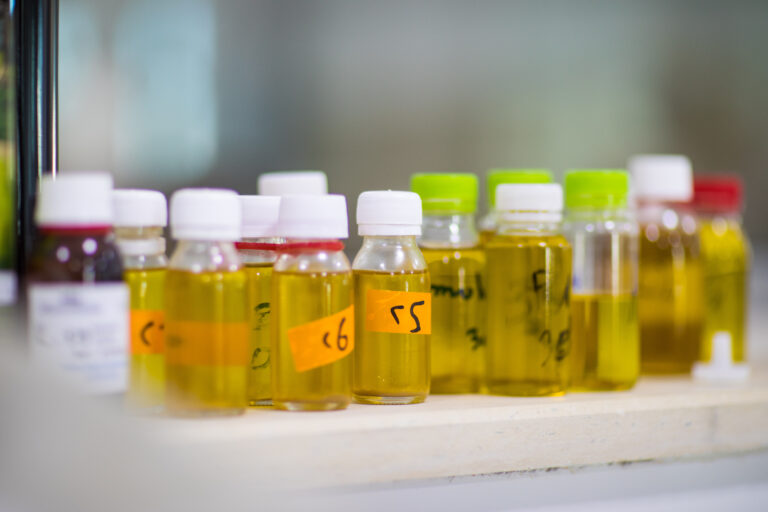
- Free acidity. Legal ceiling for extra virgin is 0.8%. It shows how much the fruit degraded before and during pressing. Lower means fresher fruit and faster milling.
- Peroxide value. Legal ceiling 20 meq O₂/kg. It shows how far oxidation has progressed, which affects shelf life.
- Polyphenols. No legal limit. Natural antioxidants; higher generally means more bitterness and pepper, and better stability.
- Stigmastadiene. Ceiling 0.05 ppm. The adulteration marker. Refining creates it; virgin oil has almost none.
The one most buyers never ask for
Free acidity is the number everybody quotes. Stigmastadiene is the number that catches fraud. If a supplier cannot produce a stigmastadiene result for the actual lot you are buying, you are relying on their word. We publish ours. Recent lots measured 0.02 and 0.01 ppm against a 0.05 ppm ceiling.
What our own lots measured
- Lot TLHP26-000146.001, certified laboratory, January 2026, 12,000 kg — free acidity 0.29%, peroxide 10.1
- Lot TLHP26-000255.001, certified laboratory, February 2026, 7,129 kg — free acidity 0.20%, peroxide 7.4
- Lot 2026B2230, ONH Sousse, March 2026, 2,056 kg — free acidity 0.35%
Against a legal ceiling of 0.8%. Tested by an independent certified laboratory, ISO/IEC 17025 accredited and recognised by the International Olive Council.
Our published specification is 0.4% or lower for OLYFO Gold and 0.5% or lower for Gold Organic and Origins. We do not quote a tighter specification than we can guarantee across every lot, and we publish what the lots actually did alongside it. How to read a certificate of analysis explains the rest of the document.
The harvest calendar, and why it decides your order date
Tunisian olives are harvested in November and December. Our fruit is pressed the same day it is picked, and oil ships from December onward.
This matters commercially. Oil bought early in the season is fresher and the choice of lots is widest. By late spring the best lots of that harvest are committed. If you want new-crop oil, the conversation starts in autumn, not in March.
Shelf life is 24 months at ambient temperature. No refrigeration needed.
The 2026/27 harvest: what to expect this season
Picking in our groves in Kairouan and Zaghouan starts at the beginning of November and runs into December. As every year, the olives are pressed the same day they are picked, and the new oil ships from December.
What to ask for this season:
- The harvest year. New-season oil comes from the 2026/27 harvest. Oil still quoted from 2025/26 is last season’s.
- The analysis of the lot you will actually receive, not of a sample from another tank.
- The variety. Chemlali, about 70% of Tunisia’s crop, is mild and fruity. Chetoui, about 16%, is greener and more peppery.
We will publish the free acidity of each new lot on this page as soon as it is tested, the same way we published last season’s: 0.29%, 0.20% and 0.35%, against a legal ceiling of 0.8%.
Certifications, and which ones your market asks for
- United States. An FDA-registered facility. Ours is registration 18131951200. For organic claims, USDA NOP.
- European Union. EU organic certification for organic claims, plus EU labelling rules.
- Gulf and Muslim-majority markets. Halal certification.
- Most retail and foodservice buyers anywhere. A food safety management standard. We hold ISO 22000 and operate HACCP.
OLYFO holds FDA registration, Ecocert TN-BIO-001 covering USDA NOP and EU Organic, ISO 22000, HACCP, Halal and Non-GMO. Kosher certification is in progress and we do not claim it as held. More on certifications and what each covers.
Formats, and how it ships
Packaged: 250 ml, 500 ml and 750 ml, 1 litre glass, and 3 litre and 5 litre metallic tins for foodservice. Bulk: drums, IBCs and flexitanks by container.
Incoterms are FOB Radès, Tunisia, with CFR or CIF on request. Formats and palletisation gives loadings per pallet and per container.
How to buy Tunisian olive oil at origin
Four things to ask any Tunisian supplier, including us.
- A certificate of analysis for the actual lot, not a generic company specification. Ask for free acidity, peroxide and stigmastadiene.
- Which variety, and from where. A supplier who cannot tell you whether it is Chemlali or Chetoui, and from which region, is a trader rather than a producer.
- The harvest date and the pressing gap. Hours between picking and milling matter more than almost anything else.
- Who owns the groves. Ask whether they farm, press, or only buy and blend. All three are legitimate. Only one gives you traceability to a grove.
Working with OLYFO
We grow olives on our own farms in Kairouan and Zaghouan, press the same day in Kairouan and Jammel, and bottle at partner facilities in Jammel and Mornag. Founded in 2020, we export to more than 12 countries across five continents.
- Minimum order. One pallet per SKU for our own brands. Three pallets per SKU for private label. One 20ft container for bulk.
- Lead time. Four to six weeks, depending on design and label work.
- Payment. 50% on confirmation, 50% when goods are ready.
- Incoterms. FOB Radès. CFR or CIF on request.
Awards: Gold at LIOOC London 2025, Olio Nuovo Days Paris 2025 and ONH Tunisia 2025. Silver at NYIOOC New York 2025 and Canada IOOC 2022. Bronze at London and Canada IOOC 2021.
Where to go next
Distribute our own brands · Start your own label · Restaurants and hotels · Bulk · Organic wholesale · UK buyers · What we supply
Or ask us for a sample and the lot analysis. We will tell you honestly if our minimums do not fit your business.
More on the organic side: Tunisian organic olive oil and how organic certification actually works. On performance under heat: the smoke point of extra virgin olive oil.
Questions
Is Tunisian olive oil good quality?
Quality varies widely between Tunisian exporters, because most Tunisian oil leaves the country in bulk for blending. Tunisia is the second largest producer in the world and produces a great deal of high grade extra virgin. Judge the supplier rather than the country: ask for a certificate of analysis for the actual lot, showing free acidity, peroxide value and stigmastadiene.
What are the main Tunisian olive varieties?
Chemlali accounts for around 70 percent of Tunisian olives and gives a milder, rounder oil. Chetoui accounts for around 16 percent and gives a greener, more assertive oil with higher polyphenols. Roughly 40 local varieties share the remaining 14 percent. Koroneiki, Greek in origin, is also grown in modern Tunisian groves.
Why is Tunisian olive oil not well known?
Because 86.3 percent of Tunisian olive oil exports leave the country in bulk and unbranded, to be blended and bottled under other labels. Only 13.7 percent leaves packaged. A great deal of Tunisian oil is already on European and American shelves without saying so.
When is the Tunisian olive harvest?
November and December. Oil ships from December onward. Buying early in the season gives the freshest oil and the widest choice of lots, because the best lots of a harvest are usually committed by late spring.