Tunisian Organic Olive Oil
Tunisia has one of the world’s largest certified organic olive-growing areas, and almost nobody outside the trade knows it. This page explains why, what it means for supply and price, and what to ask for if you are sourcing organic extra virgin olive oil from Tunisia.
Written by OLYFO in Tunisia. Last reviewed 28 August 2026.
The number
A substantial share of Tunisia’s olive-growing area is certified organic, which means organic volume is available here at scale rather than in small parcels.
Tunisia is also the world’s second largest olive oil producer overall, at roughly 500,000 tonnes in the 2025/26 season, behind only Spain. So this is not a small country with a niche organic sector. It is a major producer with a deep certified organic base.
Why Tunisia, and not Italy or Spain
Not policy, and not marketing. Geography and history.
Most Tunisian olives grow in the centre and the south, in extensive rain-fed groves. Trees are widely spaced, often 20 to 24 metres apart, because there is not enough rainfall to support dense planting. Irrigation is limited. Chemical inputs have historically been minimal, partly because the growing system does not need them and partly because they were not economic on land farmed this way.
The result is that a very large area of Tunisian olive groves was already being farmed in a way that met organic requirements before anyone applied for certification. Converting them was a matter of paperwork and inspection rather than changing how the land was worked. That is why the certified area is so large relative to other countries, and why the certification base is mature rather than newly converted.
What this means commercially
- Volume is genuinely available. Organic Tunisian oil is not a boutique line carved out of a conventional operation. Full container quantities are normal.
- The premium is smaller than you might expect. Because the organic area is so large, organic Tunisian oil does not carry the scarcity premium organic oil attracts in countries where it is a small share of production.
- Quality still varies enormously. This is the important caveat. Organic says how the olives were grown. It says nothing about how fast they reached the mill or how the oil was stored. Tunisia exports the great majority of its oil in bulk for blending, and quality across exporters ranges from excellent to indifferent.
So the organic certificate is a starting point, not an answer. Ask for the lot analysis as well. How to check any supplier’s organic claim sets out the four checks worth doing.
The varieties, and which are organic
Chemlali accounts for around 70% of Tunisian olives, Chetoui around 16%, and roughly 40 local varieties share the rest. Organic certification is not variety-specific, but in practice most certified organic Tunisian oil is Chemlali, because that is what grows in the extensive rain-fed groves of the centre and south where organic farming is most established.
Chemlali gives a milder, rounder oil with soft bitterness and a gentle finish. It suits buyers who want an approachable everyday extra virgin. More on the varieties and how to judge Tunisian oil.
OLYFO Gold Organic
Organic Chemlali from our own farms in Kairouan and Zaghouan. Hand-picked, cold pressed the same day, certified by Ecocert under TN-BIO-001 for both USDA NOP and EU Organic.
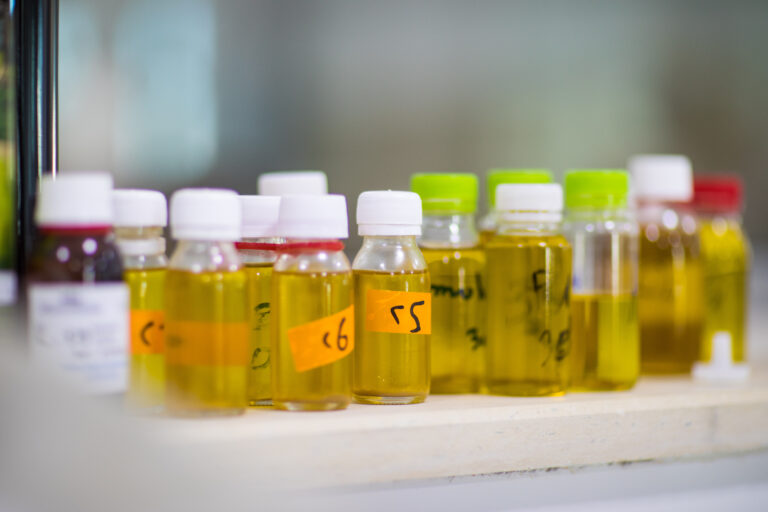
Free acidity 0.5% or below against a 0.8% legal ceiling. Polyphenols up to 500 mg/kg. Our recent lots measured 0.29%, 0.20% and 0.35% free acidity, tested by an independent certified laboratory, ISO/IEC 17025 accredited and recognised by the International Olive Council.
Formats: 250 ml, 500 ml, 750 ml and 1 litre glass, 3 and 5 litre foodservice tins, and bulk by drum, IBC or flexitank. Minimum one pallet per SKU for our own brands, three pallets per SKU for private label, one 20ft container for bulk. FOB Radès, with CFR or CIF on request.
Where to go next
OLYFO Gold Organic, full specification · Organic wholesale and bulk · Organic olive oil, a buyer’s guide · Tunisian olive oil, a buyer’s guide
Or ask for the Ecocert certificate, a sample and the lot analysis.