Organic Olive Oil: A Buyer’s Guide
Organic olive oil is one of the few food categories where the certification is genuinely worth what it costs, and one of the many where the paperwork is easy to misread. This page explains what organic certification actually requires, how USDA and EU rules differ, how to check any supplier’s claim yourself, and why so much of the world’s organic olive oil comes from Tunisia.
Written by OLYFO in Tunisia. Last reviewed 28 August 2026.
Tunisia has one of the world’s largest organic olive areas
Certified organic groves account for a substantial share of Tunisia’s olive-growing area. Our own organic range is certified by Ecocert under TN-BIO-001, covering both USDA NOP and EU Organic.
This surprises people, because Tunisia is not the name most buyers associate with organic food. The reason is historical rather than strategic: Tunisian olives have largely been grown in extensive, rain-fed groves in the centre and south, widely spaced, with very little irrigation and few inputs. A great many Tunisian groves were effectively organic long before anyone certified them. Certification formalised what was already happening.
For a buyer, that matters in two practical ways. The supply is deep rather than a boutique line, so volume is available. And the certification base is mature rather than recently converted, which shows up in traceability and record keeping.
What organic certification actually requires
Organic certification for olive oil covers the grove, the mill and the chain in between. In broad terms:
- The grove. No prohibited synthetic pesticides or fertilisers, generally for at least three years before the first certified harvest. That period is called conversion, and oil from a grove still in conversion is not organic.
- The mill. Organic and conventional fruit must not be mixed. Where a mill processes both, organic runs are separated and the equipment is cleaned between them.
- Storage and transport. Separation continues through tanks, drums and containers.
- Records. Every step is documented so a finished lot can be traced back to the grove it came from. In practice this paperwork is what certification really buys you.
- Inspection. An accredited body audits annually, and can inspect unannounced.
Note what certification does not cover: it says nothing about the grade, the acidity, the polyphenol content or the taste. Organic and extra virgin are two separate claims. An oil can be certified organic and still be a poor extra virgin, or not extra virgin at all. Always ask for both the organic certificate and the lot analysis.
USDA NOP and EU Organic are not the same thing
This trips up more first-time importers than any other part of the process.
- EU Organic is the European Union standard. Product sold as organic in the EU must be certified to it and carry the EU organic leaf, with the certifier code and the origin statement.
- USDA NOP is the United States National Organic Program. Product sold as organic in the US must be certified to NOP by a USDA-accredited certifier.
- They are separate certifications, even where equivalence arrangements exist. A supplier certified only to EU Organic cannot simply sell into the US as organic, and the reverse is equally true.
If you are shipping to both markets, ask your supplier to confirm in writing that their certificate covers both. Many do not.
OLYFO is certified by Ecocert under TN-BIO-001, covering both USDA NOP and EU Organic. More on our certifications and what each one covers.
How to check any supplier’s organic claim
You do not have to take anyone’s word for it, including ours. Four checks, in order of usefulness.
- Ask for the certificate itself, not a logo on a website. It should name the certifying body, a certificate number, the scope of what is covered, and an expiry date.
- Check the expiry date. Organic certificates are annual. An expired certificate is not a certificate.
- Check the scope covers the product you are buying. A company can be certified for one product line and not another, or for bottling but not for bulk.
- Verify with the certifier, not the supplier. Certifying bodies maintain public databases. For US organic, the USDA Organic Integrity Database lists every certified operation. If a company cannot be found there, it is not NOP certified, whatever the website says.
Organic does not mean unmeasured
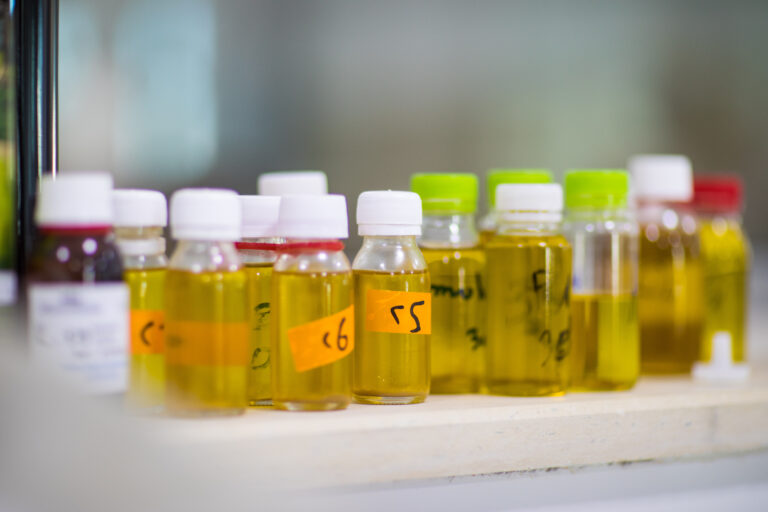
The most common mistake we see is a buyer accepting organic certification in place of a lot analysis. They answer different questions. Certification tells you how the olives were grown. The analysis tells you what is in the oil you are actually buying.
We publish both. Our recent lots measured:
- Lot TLHP26-000146.001, certified laboratory, January 2026, 12,000 kg — free acidity 0.29%, peroxide 10.1
- Lot TLHP26-000255.001, certified laboratory, February 2026, 7,129 kg — free acidity 0.20%, peroxide 7.4
- Lot 2026B2230, ONH Sousse, March 2026, 2,056 kg — free acidity 0.35%
Against a legal ceiling of 0.8% for extra virgin. Tested by an independent certified laboratory, ISO/IEC 17025 accredited and recognised by the International Olive Council. We also publish stigmastadiene, the adulteration marker: our lots measured 0.02 and 0.01 ppm against a 0.05 ppm ceiling. How to read a certificate of analysis.
Our organic oil
OLYFO Gold Organic is made from organic Chemlali olives grown on our own farms in Kairouan and Zaghouan, hand-picked and cold pressed the same day. Free acidity 0.5% or below, polyphenols up to 500 mg/kg. Certified by Ecocert under TN-BIO-001 for USDA NOP and EU Organic.
Available bottled in 250 ml, 500 ml, 750 ml and 1 litre glass, in 3 and 5 litre foodservice tins, and in bulk by drum, IBC or flexitank. Minimum one pallet per SKU for our own brands, three pallets per SKU for private label, one 20ft container for bulk. Incoterms FOB Radès, with CFR or CIF on request.
Where to go next
Organic wholesale and bulk · Tunisian olive oil, a buyer’s guide · Organic private label · Buyer questions answered
Or ask us for the certificate, a sample and the lot analysis. All three, before you commit to anything.
Questions
Does organic certification mean the olive oil is extra virgin?
No. Organic and extra virgin are two separate claims. Organic certification covers how the olives were grown and handled. It says nothing about grade, acidity, polyphenols or taste. An oil can be certified organic and still be a poor extra virgin, or not extra virgin at all. Ask for both the organic certificate and the lot analysis.
Is USDA organic the same as EU organic?
No. USDA NOP and EU Organic are separate certifications, even where equivalence arrangements exist. A supplier certified only to EU Organic cannot automatically sell as organic in the United States, and the reverse is also true. If you ship to both markets, ask the supplier to confirm in writing that the certificate covers both.
How do I check a supplier organic certificate?
Ask for the certificate itself rather than a logo, and check it names the certifying body, a certificate number, the scope of what is covered and an expiry date. Certificates are annual. Then verify with the certifier rather than the supplier: certifying bodies maintain public databases, and for US organic the USDA Organic Integrity Database lists every certified operation.
Is Tunisian organic olive oil certified for both the US and the EU?
Not automatically. USDA NOP and EU Organic are separate certifications and a supplier certified for one cannot sell as organic in the other. OLYFO is certified by Ecocert under TN-BIO-001, which covers both. Ask any supplier to confirm in writing, and verify a US certificate in the USDA Organic Integrity Database.