How to Start Your Own Olive Oil Brand
Written by OLYFO in Tunisia. Last reviewed 7 August 2026.
You do not need a grove or a mill to sell olive oil under your own name. Nearly every new brand starts the same way: a producer grows, presses, bottles and certifies the oil, and it leaves the factory in your packaging with your label on it. That arrangement is called private label. You bring the brand, the market and the order. The producer brings the harvest, the laboratory and the export paperwork.
This page sets out how it works in practice — the decisions you have to make, what really moves the price, which certificates each market wants, and why the harvest calendar decides your launch date. OLYFO has been doing this from Tunisia since 2020. Where a number below is ours, we give it. Where it depends on your project, we say so rather than guess.
The short version
- Start with private label unless you have a specific reason not to. It is the only route that gets a finished, certified bottle into your hands in one season.
- Choose the market before the oil. Labelling rules, certification and even bottle sizes follow the destination, not your taste.
- Expect to commit to a real quantity. With OLYFO, private label starts at three pallets per SKU. Bulk starts at one full 20-foot container.
- Work backwards from the harvest. Tunisian olives are picked in November and December. Oil from that harvest ships from December.
- Ask for the certificate of analysis for your actual lot — not the figure on a brochure.
Two ways in
| Private label | Buy bulk and bottle it yourself | |
|---|---|---|
| What you do | Choose the oil, the format and the label. The producer presses, bottles, certifies and ships. | Buy oil in flexitank, drums or IBC totes and bottle it in your own country. |
| What you need | A label design, a destination market and somewhere to sell. | A bottling partner, a packaging supply chain, and someone who can handle import and food-safety compliance. |
| Suits you if | You are launching a brand, testing a market, or supplying retail or foodservice under your own name. | You already have bottling, or your market pays more for oil bottled locally. |
There is a third route: plant the trees, farm them and press your own oil. That is a farming business rather than a brand business, and it is years before there is anything in a bottle. Very few people starting a brand should begin there.
The eight decisions
1. Which market
Decide this first, because everything else follows it. The United States wants an FDA-registered facility and a Nutrition Facts panel. The European Union has its own labelling rules and its own organic scheme. A Gulf market will ask about Halal. Choosing the market last is the most expensive mistake on this page.
2. Which oil
Tunisia’s signature variety is Chemlali — soft and buttery, with almond and ripe apple, and a light bitterness. Koroneiki is fruitier, more peppery, and holds its character longer. Chetoui is intense and green, and naturally high in polyphenols. Oueslati sits in the middle and is aromatic. Taste them against the food your customers actually eat, not on a spoon in a tasting room.
3. Which format
OLYFO bottles in 250 ml, 500 ml, 750 ml and 1 litre glass, plus 3 litre metallic tins. Retail shelves and foodservice kitchens want different things, and the bottle you choose sets the label size, the case count and the pallet maths. Choose the bottle before you commission the artwork.
4. Organic or not
Organic certification is a real cost and a real premium. It is worth it in some markets and dead weight in others. OLYFO’s organic range is certified USDA NOP Organic and EU Organic through Ecocert under the code TN-BIO-001, so the certificate travels with the oil rather than needing to be built from scratch.
5. How much
Private label with OLYFO starts at three pallets per SKU. Our own bottled brands start at one pallet per SKU. Bulk starts at one full 20-foot container. Ordering below a sensible quantity does not save money — the freight per bottle simply eats the difference.
6. The label
Your label has to carry the legal grade, the origin, the lot code, the best-before date, the nutrition panel and the certification marks you are entitled to use — and then, in whatever room is left, your brand. Designers who have not done food packaging before routinely lay out the brand first and discover the mandatory text does not fit.
7. The price you want to sell at
Work backwards. Take your shelf price, remove the retailer’s margin, your margin, freight, duty and the landed cost of the bottle, and see what is left for the oil. If that number is below what real extra virgin olive oil costs, the answer is a smaller bottle or a different market, not a cheaper oil.
8. Who owns the quality record
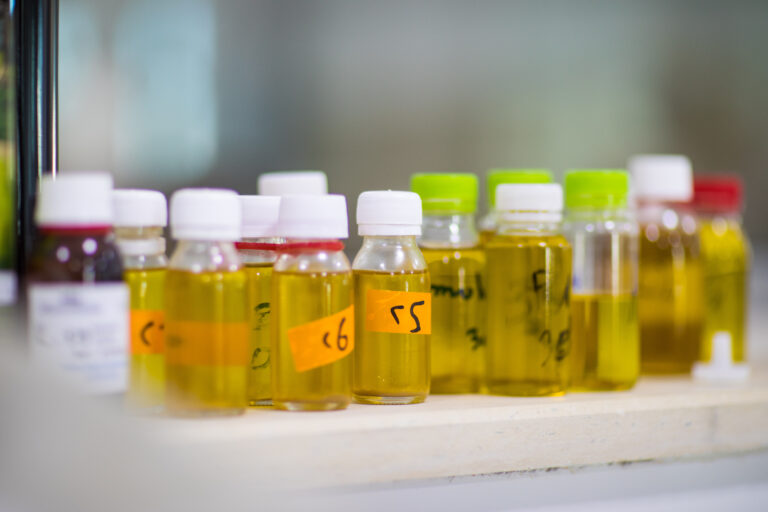
Every lot should ship with a certificate of analysis showing free acidity, peroxide value and a sensory result for that specific lot. Keep those records. If a buyer, an importer or a regulator ever asks, the certificate is the answer, and a brochure figure is not.
What it costs
We do not publish a price list, and it is worth understanding why. Olive oil is an agricultural product. Its price moves with each harvest, with the variety, and with the grade. A price list published in advance is either out of date or padded enough to survive a bad year.
What moves your number:
- The variety and the grade. A high-polyphenol Chetoui and a standard Chemlali are not the same product and do not cost the same.
- Conventional or organic. Certification carries a cost through the whole chain, from the grove to the paperwork.
- The format. Glass, closures and cartons are a large share of a small bottle’s cost. A 250 ml bottle costs far more per litre of oil than a 3 litre tin.
- The volume. Three pallets and three containers are different conversations.
- The freight and the terms. We quote FOB Radès, Tunisia. What happens after Radès depends on your destination and your forwarder.
Tell us the market, the volume, the format and the grade, and you get a real number against a real specification.
The certificates you actually need
“Extra virgin” is a legal grade, not a marketing phrase. It requires free acidity at or below 0.8%, plus a sensory panel finding no defects. OLYFO Gold runs at or below 0.4% — roughly half the limit.
- United States. The facility must hold an FDA food facility registration. OLYFO’s is No. 18131951200. Your label needs a Nutrition Facts panel in the US format.
- European Union. EU food law and EU labelling rules apply, and organic claims need EU organic certification.
- Organic. OLYFO’s organic range is certified USDA NOP Organic and EU Organic through Ecocert, code TN-BIO-001, verified by annual third-party inspection.
- Food safety at the plant. Our oils are bottled at partner facilities operating under ISO 22000 and HACCP, with Halal and Non-GMO certification. Kosher certification is in progress.
- Per lot. A certificate of analysis covering free acidity, peroxide value and sensory profile.
The harvest decides your calendar
Tunisian olives are picked in November and December and pressed the same day. Oil from that harvest ships from December. Shelf life is 24 months from production, stored at room temperature — olive oil needs no refrigeration, but it does hate light and heat.
So a brand aiming to launch in spring is ordering against the December harvest before it, and a brand that starts talking to producers in March is usually looking at the following season. Start earlier than feels necessary.
The mistakes that cost people a season
- Commissioning the label artwork before choosing the bottle.
- Choosing an oil by its medals instead of tasting it against the food it will be sold with.
- Leaving certification to the end, then discovering the destination market needs something the oil does not have.
- Ordering a token quantity and being surprised by the freight cost per bottle.
- Accepting a brochure specification instead of the certificate of analysis for the lot being shipped.
- Missing the harvest and losing a year.
What OLYFO brings to it
We grow olives on our own farms in Kairouan and Zaghouan, press in Kairouan and Jammel, and bottle and store at partner facilities in Jammel, Monastir and Mornag, Tunis. We have been exporting since 2020, to more than twelve countries across five continents.
| Oil | Variety | Free acidity | Polyphenols |
|---|---|---|---|
| OLYFO Gold | Koroneiki | ≤ 0.4% | up to 400 mg/kg |
| OLYFO Gold Organic | Chemlali, organically farmed | ≤ 0.5% | up to 500 mg/kg |
| OLYFO Origins | Chemlali | ≤ 0.5% | up to 400 mg/kg |
The oils have won Gold at the London International Olive Oil Competition, Gold at Olio Nuovo Days in Paris, Gold at ONH in Tunisia and Silver at NYIOOC in New York, all in 2025, and Silver at the Canada IOOC in 2022. OLYFO Origins was first recognised at the London and Canada IOOC in 2021. Every one of those panels tastes blind.
For bulk buyers we supply flexitanks of roughly 22,000 litres, drums and 1,000 litre IBC totes, in conventional and organic grades, across Chemlali, Chetoui, Koroneiki and Oueslati.
Start a project
Walk through variety, format and certification step by step at plp.olyfo.com, our private label pathway. You will get a specification you can put in front of a buyer.
Or talk to a person. Email sales@olyfo.com, or call and WhatsApp +216 25 217 199. Tell us the market, the volume and the grade, and we will come back with a specification and a quote. You can also send an enquiry through the contact page.
Buying unbottled instead? See bulk olive oil. Already know you want private label? See private label olive oil. Looking specifically for organic? See organic EVOO wholesale.
Full specifications: OLYFO Gold · OLYFO Gold Organic · OLYFO Origins — each with harvest date, tasting notes, nutrition and what the certificate of analysis covers.
Packing and logistics: see formats, palletisation and container loads — units per case, cases per pallet and how much fits in a 20 or 40-foot container, for every format.
Market context: read The Tunisian Olive Oil Harvest Report — production, export volumes and destinations for the current season, updated each harvest and fully sourced.
Questions people ask
Can I start an olive oil brand without owning a farm?
Yes. Most olive oil brands on a supermarket shelf do not own a grove or a mill. They buy from a producer under private label, which means the producer grows, presses, bottles and certifies the oil and ships it in your packaging under your name. OLYFO does this from Tunisia with a minimum of three pallets per SKU.
What is the minimum order for private label olive oil?
With OLYFO, private label starts at three pallets per SKU. Our own bottled brands start at one pallet per SKU, and bulk oil starts at one full 20-foot container. Ordering below those quantities pushes the freight cost per bottle high enough to remove your margin.
How much does it cost to start an olive oil brand?
There is no single figure, because olive oil is priced by harvest, variety and grade. The cost of your project is driven by the variety and grade you choose, whether it is organic, the bottle format, the volume you order, and freight from Tunisia. OLYFO quotes against a written specification rather than publishing a price list. Send us the market, the volume, the format and the grade and you will get a real number.
How long does it take to launch an olive oil brand?
The harvest sets the pace. Tunisian olives are picked in November and December and oil from that harvest ships from December. Certification, label artwork and export documentation all have to be finished before that window. A brand that starts the conversation in spring is usually planning for the following season.
Do I need organic certification?
Only if your market pays for it. Organic certification adds cost through the whole chain. It is worth it where buyers actively look for it and dead weight where they do not. OLYFO’s organic range is certified USDA NOP Organic and EU Organic through Ecocert under code TN-BIO-001, so the certification already exists rather than having to be built.
What certificates do I need to sell olive oil in the United States?
The producing facility needs an FDA food facility registration — OLYFO’s is No. 18131951200 — and your label needs a Nutrition Facts panel in the US format. Any organic claim needs USDA NOP certification. Each shipment should travel with a certificate of analysis for that lot.
Why Tunisia rather than Italy or Spain?
Tunisia is one of the world’s largest olive oil producers, and a large share of its harvest is exported in bulk to Italy and Spain, where it is blended and bottled under European labels. Buying Tunisian-origin oil directly means buying at source, traceable to the grove, at its freshest. Tunisian oils win Gold at the same competitions European oils do.
What is a certificate of analysis and why does it matter?
It is a laboratory report for the specific lot you are buying, covering free acidity, peroxide value and a sensory assessment. It is the difference between what a brochure claims and what is in the bottle you received. Ask for it every time, and keep it.
New to this origin? Our guide to Tunisian olive oil covers the varieties, why Tunisia has one of the largest certified organic olive areas in the world, and how to judge quality before you buy.