The Tunisian Olive Oil Harvest Report
Updated 8 August 2026. Covering the 2025/26 season, with export data to June 2026. Next update: December 2026, when the 2026/27 harvest is pressed.
The 2025/26 season was the biggest in Tunisia’s history. Production reached roughly 500,000 tonnes, putting Tunisia second in the world behind Spain, and exports in the first eight months ran 56.7% ahead of the year before. This page sets out what happened, where the oil went, and what it means if you are buying.
We publish this because the numbers that matter to buyers are scattered across government bulletins and trade press, and because we are in the groves. It is updated each harvest and every figure is sourced.
The headline
| 2025/26 | Previous season | Change | |
|---|---|---|---|
| Production | ~500,000 t | — | Record; second in the world |
| Exports, first 8 months | 352,000 t | 224,600 t | +56.7% |
| Export value, first 8 months | TND 4.3945 bn | TND 3.0304 bn | +45% |
Volumes grew faster than values. That is the whole shape of the season in one line: a lot more oil moved, and it moved at prices that rose only slightly. Average export prices per kilo were up around 3% year on year — effectively flat against a 57% jump in volume.
Where Tunisian olive oil actually goes
| Region | Share of export volume |
|---|---|
| European Union | 56.8% |
| North America | 24.2% |
| Asia | 11.3% |
| Africa | 3.9% |
By individual country: Spain took 32.4%, Italy 19.7% and the United States 19.4%.
The number nobody puts on a label
86.3% of Tunisia’s olive oil exports left the country in bulk. Only 13.7% left in a package.
Read that alongside the destination table. Spain and Italy together took over half of Tunisia’s exports, and almost all of it travelled unbottled. That oil is blended, bottled and sold under European labels, and the shopper buying it will never see the word Tunisia.
This is not a scandal — it is how the trade has worked for decades, and Tunisian oil has to be good for Italian and Spanish bottlers to want that much of it. But it does mean two things for anyone buying:
- If you have bought Italian or Spanish extra virgin olive oil, there is a fair chance you have already tasted Tunisian oil without being told.
- Buying at origin removes a step. Fewer hands, fewer blends, and the lot you receive is traceable to the grove it came from.
Extra virgin accounted for 83.4% of the volume exported, so this is not a story about low-grade oil leaving the country. It is high-grade oil leaving anonymously.
What this means if you are buying
- Supply is good and paperwork is the bottleneck, not availability. After a record crop, the constraint on a shipment is certification and documentation, not whether the oil exists.
- Prices did not collapse despite the volume. A 57% rise in volume against a 45% rise in value means the market absorbed the crop without a price crash. Anyone quoting you a distress price should be asked why.
- Ask where the oil was pressed, not just where it was bottled. Given the bulk figures, “bottled in Italy” tells you very little about origin.
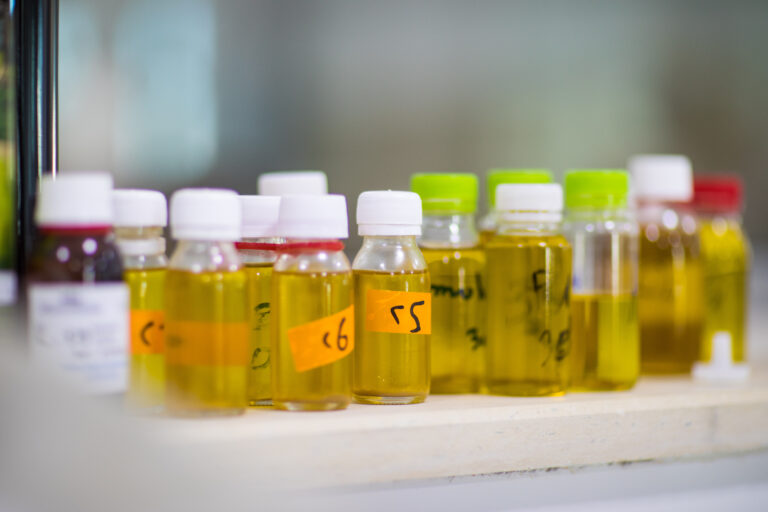
- Get the certificate of analysis for the lot. In a big year the range of quality widens, because more marginal fruit gets picked. The lot certificate is the only thing that tells you what you actually bought.
- Watch the daily market, not the annual headline. Olive oil moves daily and a season summary is months out of date by the time you sign. OleaIndex publishes a daily olive oil benchmark, including a Tunisian variety index covering Chemlali from Kairouan and Chetoui from Zaghouan — the same varieties and regions we grow — alongside Spain, Italy, Greece, Turkey and Portugal. It is free to read and it publishes its methodology.
The 2026/27 season
Tunisian olives are picked in November and December 2026, and oil from that harvest ships from December. Nothing meaningful about volume or quality can be said before the fruit is on the trees and the weather through autumn is known — and forecasts published before then have a poor record.
To put that plainly: pre-season estimates for 2025/26 ranged from about 250,000 to 500,000 tonnes depending on who was asked. The top of that range turned out to be right, but a buyer who had planned against the bottom of it would have been badly wrong. Treat early forecasts as weather commentary, not as procurement data.
What we will report in December 2026: when picking started, what the fruit was like, the free acidity and polyphenol readings coming off our first presses, and the national production figure once it is published.
Where OLYFO sits in this
We grow on our own farms in Kairouan and Zaghouan, press in Kairouan and Jammel, and bottle and store at partner facilities in Jammel, Monastir and Mornag, Tunis. We work with Chemlali, Chetoui, Koroneiki and Oueslati.
We sell both ways: in bulk, like most of the country, and bottled under our own labels or yours. The difference is that when you buy from us, you know it is Tunisian, you know which grove, and the certificate of analysis names the lot.
| Oil | Variety | Free acidity | Polyphenols |
|---|---|---|---|
| OLYFO Gold | Koroneiki | ≤ 0.4% | up to 400 mg/kg |
| OLYFO Gold Organic | Chemlali, organically farmed | ≤ 0.5% | up to 500 mg/kg |
| OLYFO Origins | Chemlali | ≤ 0.5% | up to 400 mg/kg |
Sources
Every figure on this page comes from one of the following. Where sources disagree we say so rather than picking the flattering number.
- Export volumes, values, product mix and destinations — National Observatory of Agriculture (ONAGRI), Tunisia, covering November 2025 to June 2026.
- Production volume and world ranking — International Olive Council (IOC).
- Pre-season forecast range — FAO, USDA Foreign Agricultural Service and trade press published before and during the 2025/26 season.
- Daily price levels — OleaIndex, which publishes a daily olive oil benchmark by origin and grade, including a Tunisian variety index for Chemlali and Chetoui, with a published methodology.
If you find a figure here that has been superseded, tell us and we will correct it: sales@olyfo.com.
How this report is maintained
It is rewritten after each harvest — in December, when the first oil of the new season is pressed, and again when the national export figures are published. The date at the top of the page is the date the figures were last checked, not the date the page was created.
Talk to us
Email sales@olyfo.com or call and WhatsApp +216 25 217 199. For packing and container quantities see formats and palletisation. Launching your own label? Read how to start your own olive oil brand. In Britain? See our UK page.
Questions
How much olive oil did Tunisia produce in 2025/26?
Around 500,000 tonnes, a national record, which made Tunisia the world’s second-largest olive oil producer for the season behind Spain, according to the International Olive Council. Pre-season forecasts had ranged from roughly 250,000 to 500,000 tonnes.
How much olive oil does Tunisia export, and where to?
In the first eight months of the 2025/26 season Tunisia exported 352,000 tonnes, up 56.7% on the 224,600 tonnes shipped in the same period a year earlier, worth TND 4.3945 billion. The European Union took 56.8% of volume, North America 24.2%, Asia 11.3% and Africa 3.9%. Spain alone took 32.4%, Italy 19.7% and the United States 19.4%. Source: ONAGRI.
Is most Tunisian olive oil sold in bulk or bottled?
Overwhelmingly bulk. In the first eight months of 2025/26, 86.3% of Tunisian olive oil exports left in bulk and only 13.7% in packaged form. Much of the bulk oil goes to Spain and Italy, where it is blended and bottled under European labels, which is why so little Tunisian oil is recognised as Tunisian on the shelf.
When is the Tunisian olive harvest?
November and December. OLYFO’s olives are hand-picked and pressed the same day, and oil from each harvest ships from December. Shelf life is 24 months from production.
Did olive oil prices fall in the 2025/26 season?
No. Despite export volumes rising 56.7%, export value rose 45% and average export prices per kilo were up roughly 3% year on year. The market absorbed a record crop without a price collapse.
New to this origin? Our guide to Tunisian olive oil covers the varieties, why Tunisia has one of the largest certified organic olive areas in the world, and how to judge quality before you buy.