What does a certificate of analysis actually show?
Figures from three consecutive export shipments, January to March 2026. Last reviewed 8 August 2026.
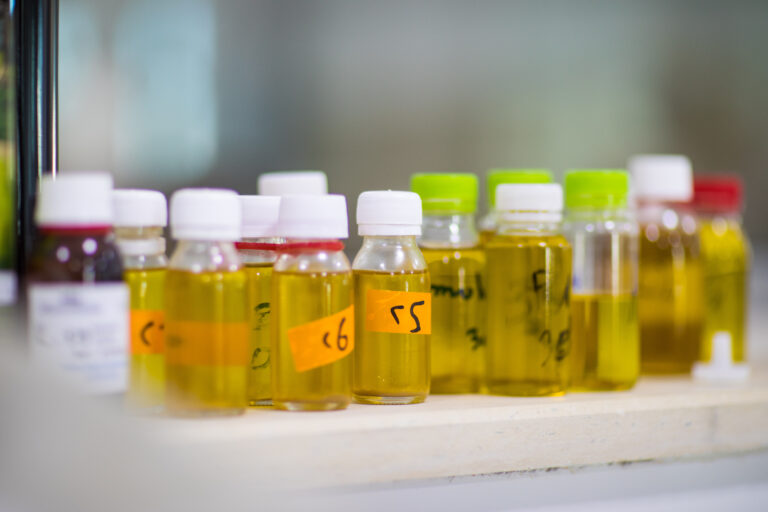
Every consignment we ship travels with a laboratory report on that specific lot. Most olive oil buyers are shown a company specification, which is a promise. A certificate of analysis is a measurement. This page explains what is on one, what the numbers mean, and what ours actually said on our last three shipments.
Our last three shipments
| Report | Date | Free acidity | Peroxide value | Classification |
| Certified lab, TLHP26-000146.001 | January 2026 | 0.29% | 10.1 | Extra virgin |
| Certified lab, TLHP26-000255.001 | February 2026 | 0.20% | 7.4 | Extra virgin |
| ONH 2026B2230 | March 2026 | 0.35% | — | Extra virgin |
The legal ceiling for extra virgin free acidity is 0.80%. Our published specification is 0.4% or less for OLYFO Gold and 0.5% or less for Gold Organic and Origins. The measured results above sit between a quarter and a half of the legal limit.
We publish the specification rather than the best result, deliberately. A specification is what we commit to on every lot, in every season. A single flattering number is not a promise, and any supplier quoting you one should be asked for the report behind it.
Who does the testing
- An independent certified laboratory — an oils and fats laboratory accredited to ISO/IEC 17025:2017 and recognised by the International Olive Council. It is independent of OLYFO and has no commercial interest in the result.
- Office National de l’Huile (ONH), Sousse — the Tunisian national olive oil authority’s own laboratory.
Both are independent of us. That is the point of them.
How to read the numbers
Free acidity
Expressed as oleic acid. It measures how much the fruit degraded between picking and pressing. High acidity means damaged fruit, or fruit left in sacks overnight, or a slow mill. It is the number most people quote and the one most easily controlled by pressing quickly. Legal limit for extra virgin: 0.80%.
Peroxide value
How far oxidation has started. Fresh, well-handled oil is low; oil that has been warm, or exposed to air or light, climbs. Legal limit: 20 meq O2/kg. Our January and February lots measured 10.1 and 7.4 — roughly half the ceiling and under, which is what you would expect from oil pressed the day it was picked.
K232, K270 and delta-K
Ultraviolet absorbency. These catch oxidation and, importantly, the presence of refined oil. Limits are 2.50, 0.22 and 0.01. Our January lot: 2.26, 0.13 and 0.00. February: 1.99, 0.17 and −0.01.
Stigmastadiene — the one to ask about
This is the adulteration marker, and most buyers have never heard of it. Refining creates stigmastadienes; genuine virgin oil contains almost none. The ceiling is 0.05 ppm. Our lots measured 0.02 and 0.01 ppm. If you take one question away from this page, make it “what was the stigmastadiene figure?” The answer tells you whether you are being sold virgin oil or a blend.
ECN42 difference
Detects seed oil contamination by comparing the real triglyceride composition against the theoretical one. Limit 0.20%. Both our lots measured 0.03%.
The sensory panel
A trained panel tastes the oil for defects — fusty, musty, winey, rancid. An oil can pass every chemical test and still fail here, and that is why the panel result matters. All three lots above were classified extra virgin on both the chemistry and the panel.
What a certificate does not cover
A trade certificate of analysis answers the questions in the olive oil trade standard: is this oil what it claims to be, and how well was it made. It is not a general safety screen, and three things people assume are on it usually are not.
- Contaminant testing. Pesticide residues, mineral oil hydrocarbons and plasticisers are separate analyses, and they are not part of a standard trade certificate. If your market requires any of them, say so early rather than after the goods are made — tell us what you need and we will come back on what can be arranged for your shipment.
- The harvest date. A certificate carries the date of the test, which can be months after pressing. If you want to know how old the oil is, ask for the pressing date as well.
- Anything beyond the lot in front of you. A certificate describes one lot. It says nothing about the next one, which is why the date and the lot number on it matter as much as the figures.
What to do with this when you are buying
- Ask for the certificate of analysis for the actual lot, not a company specification and not last season’s report.
- Check who signed it. An ISO/IEC 17025 accredited, IOC-recognised laboratory is a different thing from an in-house test.
- Read past the acidity. Acidity is easy to present well. Peroxide value, delta-K and stigmastadiene are where a problem shows.
- Compare the date on the report to the harvest. A report from two seasons ago describes oil you are not buying.
This matters more from Tunisia than almost anywhere, because 86.3% of the country’s exports leave in bulk and are bottled elsewhere. See the harvest report.
Ask for ours
Tell us the grade and format you are considering and we will send the current analysis with the quotation rather than after it. Send an enquiry or write to sales@olyfo.com.
Related: grades of olive oil · certifications · become a distributor.
Questions
What is a certificate of analysis for olive oil?
A laboratory report on one specific lot of oil. It measures free acidity, peroxide value, the ultraviolet absorbency figures K232, K270 and delta-K, purity markers such as stigmastadiene and the ECN42 difference, and it records the verdict of a trained sensory panel. Together those decide whether the oil is legally extra virgin.
What free acidity does OLYFO actually achieve?
Our published specification is 0.4% or less for OLYFO Gold and 0.5% or less for Gold Organic and Origins, against a legal extra virgin limit of 0.8%. Across three consecutive export shipments in January, February and March 2026 the measured results were 0.29%, 0.20% and 0.35%.
Who tests OLYFO olive oil?
An independent oils and fats laboratory accredited to ISO/IEC 17025 and recognised by the International Olive Council, and the laboratory of the Office National de l’Huile in Sousse. Both are independent of OLYFO.
How can I tell if an olive oil has been adulterated with refined oil?
Look at the stigmastadiene figure. Refined oil contains stigmastadienes; genuine virgin oil contains almost none. The legal ceiling is 0.05 ppm. Our January and February 2026 lots measured 0.02 and 0.01 ppm. Also check the delta-K value, which should be at or near zero.
What is a good peroxide value for olive oil?
The legal limit for extra virgin is 20 meq O2/kg. A low figure indicates fresh, well-handled oil that has not begun to oxidise. Our January and February 2026 lots measured 10.1 and 7.4.
Will you send me the analysis before I order?
Yes. Ask for the certificate of analysis for the lot you are being offered, not a generic company specification. If a supplier will not give you one, that is your answer.