What grades of olive oil can you buy?
Last reviewed 8 August 2026.
OLYFO sells extra virgin only. But buyers are quoted every grade, often without the difference being explained, so here is the whole ladder in plain language — and where the words on a label stop meaning what you think they mean.
The grades, top to bottom
- Extra virgin olive oil. Pressed mechanically, no heat or solvent, free acidity of 0.8% or less, and no sensory defect when a trained panel tastes it. Both tests have to pass. This is the only grade we sell.
- Virgin olive oil. Same mechanical process, free acidity up to 2%, and minor sensory defects allowed. Edible, sold as it is, a step down in flavour and stability.
- Lampante. Virgin oil that failed. Too acidic or too defective to eat. Its name comes from lamp oil. It has to be refined before it can go anywhere near food.
- Refined olive oil. Lampante that has been chemically refined — neutralised, bleached, deodorised. Safe, stable, almost flavourless, and stripped of most of the polyphenols that made the original fruit interesting.
- Olive oil (sometimes labelled “pure”). Refined oil with a little virgin oil blended back in to give it some taste. Perfectly legitimate. Not extra virgin.
- Olive pomace oil. Extracted with solvent from the paste left after pressing, then refined. It is the cheapest thing in the category that is still allowed to carry the word olive.
Where buyers get caught
Three traps, in the order we see them.
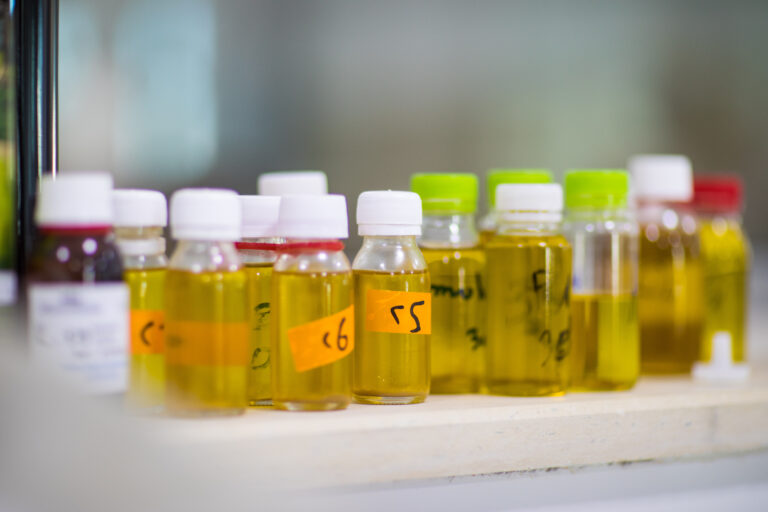
- Acidity quoted without a panel result. Free acidity is a laboratory number and it is easy to hit. The sensory panel is the harder test, because it catches fusty, musty and winey defects that no chemical figure shows. A supplier who will quote you the acidity but not the panel result is telling you something.
- “Cold pressed” doing the work of a grade. It is a process description, not a quality classification. Extra virgin is the classification.
- A blend described by its best component. Ask for the certificate of analysis for the specific lot you are being offered, not a generic company specification. Ours travels with every consignment, and it beats any number published on this website, including ours.
What we actually supply
- OLYFO Gold — single-variety Koroneiki, free acidity 0.4% or less, polyphenols up to 400 mg/kg. Full specification.
- OLYFO Gold Organic — certified organic Chemlali, free acidity 0.5% or less, polyphenols up to 500 mg/kg. Full specification.
- OLYFO Origins — Chemlali, free acidity 0.5% or less, polyphenols up to 400 mg/kg. Full specification.
All three are at roughly half the legal extra virgin ceiling of 0.8%, from olives picked in November and December and pressed the same day they are picked. Shelf life is 24 months from production, stored at ambient temperature away from light.
Why the grade matters more from Tunisia than anywhere else
Extra virgin was 83.4% of Tunisia’s export volume in 2025/26, and 86.3% of those exports left the country in bulk. High-grade Tunisian oil leaves anonymously, gets blended and bottled elsewhere, and comes back on somebody else’s label. If you buy at origin you can specify the grade, see the analysis for your own lot, and know what is in the bottle. That is the whole argument, and it is a published statistic rather than a sales line. See the harvest report.
Next
Tell us the grade, the variety and the format you need and we will send the specification and the analysis. Send an enquiry or write to sales@olyfo.com.
Related: certifications · how olive oil is priced · organic EVOO wholesale.