How to tell if olive oil is real
Figures from three consecutive export shipments, January to March 2026. Last reviewed 1 September 2026.
There is a short answer and a useful one. The short answer is that you cannot tell by looking, and the tests that circulate online do not work. The useful answer is that authenticity is a laboratory question with five specific numbers behind it, any supplier can be asked for all five, and two of those five are the ones that actually matter. This page explains both, and shows what the numbers said on our own last three shipments.
The tests that do not work
The fridge test
The claim is that real olive oil solidifies in the refrigerator and fake oil does not. Whether an oil thickens in the cold depends on its fatty acid composition, which varies by variety, by how ripe the fruit was at picking and by how long the oil has been stored. A Chemlali oil and a Koroneiki oil behave differently in the same fridge and both are genuine. Refined and blended oils can cloud too. The test tells you something about composition and nothing about authenticity.
Colour
Green tells you about chlorophyll — the variety, the ripeness of the fruit, and whether leaves went into the mill with it. Good oil runs from pale gold to deep green. Colour is deliberately excluded from official grading, which is why the tasting glasses used by professional panels are coloured blue: so the panel cannot see it.
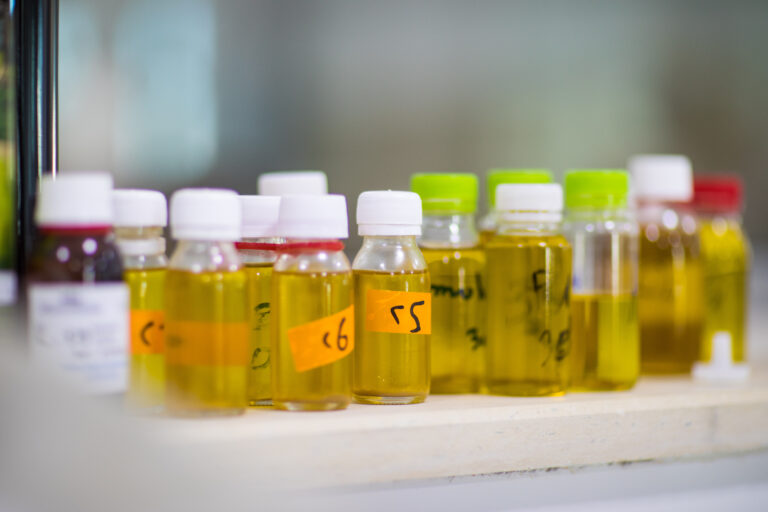
Taste does work, but only in a trained mouth. A trained sensory panel is one of the two official methods for classifying olive oil, alongside the chemistry, and it looks for specific defects — fusty, musty, winey, rancid. An oil can pass every chemical test and still fail the panel.
The five numbers that answer the question
| Test | What it catches | Limit, extra virgin | Our last lots |
|---|---|---|---|
| Free acidity | Fruit damaged between picking and pressing | 0.80% | 0.29% · 0.20% · 0.35% |
| Peroxide value | How far oxidation has gone | 20 meq O₂/kg | 10.1 · 7.4 |
| K232 / K270 / ΔK | Oxidation, and refined oil | 2.50 / 0.22 / 0.01 | 2.26 / 0.13 / 0.00 1.99 / 0.17 / −0.01 |
| ECN42 difference | Seed oil blended in | 0.20% | 0.03% · 0.03% |
| Stigmastadiene | Refined oil blended in | 0.05 ppm | 0.02 · 0.01 ppm |
Three of these measure quality. Two of them measure authenticity. It is worth knowing which is which, because they answer different questions and most buyers treat them as one.
Free acidity, peroxide value and the ultraviolet figures describe how well the oil was made and how well it has been kept since. A poor result means fruit that sat too long before pressing, or oil that has been warm, or oil that is simply old. It does not on its own mean the oil is not olive oil.
ECN42 and stigmastadiene are different. They are the two that answer the question this page is about.
Stigmastadiene — the one question to ask
Refining creates stigmastadienes. Oil pressed mechanically and never refined contains almost none. The ceiling for virgin grades is 0.05 ppm. Our January and February lots measured 0.02 and 0.01. If refined oil has been blended into a consignment sold as extra virgin, this is the number that shows it — and it is the number fewest buyers think to ask for. If you take one question away from this page, make it that one.
ECN42 — the seed oil check
This compares the oil’s actual triglyceride composition against the composition olive oil should theoretically have. Sunflower, soya or canola blended in pushes the two apart. The limit is 0.20%. Both of our tested lots measured 0.03%.
What a real certificate looks like
- It names a lot, not a company. A certificate for “our extra virgin olive oil” is not a certificate.
- It carries a date you can compare against the harvest. A report from two seasons ago describes oil you are not buying.
- It is signed by an accredited laboratory. Ours are signed by SGS Tunisia’s oils and fats laboratory, accredited to ISO/IEC 17025:2017 under accreditation number 1-0008 and recognised by the International Olive Council, and by the laboratory of the Office National de l’Huile in Sousse, the Tunisian national olive oil authority.
- It reports the sensory panel as well as the chemistry.
- It is a measurement, not a promise. A company specification is a promise. The two are not interchangeable and should not be presented as though they were.
Five questions for any supplier
- Can I see the certificate of analysis for the lot you are offering me, rather than a sample lot or last season’s?
- What was the stigmastadiene figure?
- Which laboratory signed it, and is it accredited?
- What date was the oil pressed, and what date was it tested?
- Was a sensory panel run, and what did it classify the oil as?
You are entitled to ask all five. A supplier who cannot answer them has told you something.
Ask for ours
Tell us the grade and format you are considering and we will send the current certificate of analysis with the quotation rather than after it. Send an enquiry or write to sales@olyfo.com.
Going further: what a certificate of analysis actually shows, our grades of olive oil, and how olive oil is certified. If you are buying at volume, see bulk olive oil from Tunisia.
Questions
Can you tell if olive oil is real by putting it in the fridge?
No. Whether olive oil thickens in the cold depends on its fatty acid composition, which varies between varieties and harvests. Genuine oils behave differently from one another, and adulterated oils can cloud as well. The fridge test does not distinguish them.
What is the best test for adulterated olive oil?
Stigmastadiene. Refining creates it and virgin oil contains almost none, so it reveals refined oil blended into a virgin consignment. The ceiling for virgin grades is 0.05 ppm. ECN42 difference, with a limit of 0.20%, catches seed oil in the same way.
Does the colour of olive oil tell you anything about quality?
It tells you about variety and ripeness, not quality or authenticity. Colour is excluded from official grading, and professional tasting glasses are coloured blue so that the panel cannot see the oil.
What should I ask a supplier for?
The certificate of analysis for the specific lot being offered, signed by an accredited laboratory, with the pressing date and the sensory panel result on it — not a company specification.