Acidity in Olive Oil – What the Numbers Really Mean
🗓 29.06.26
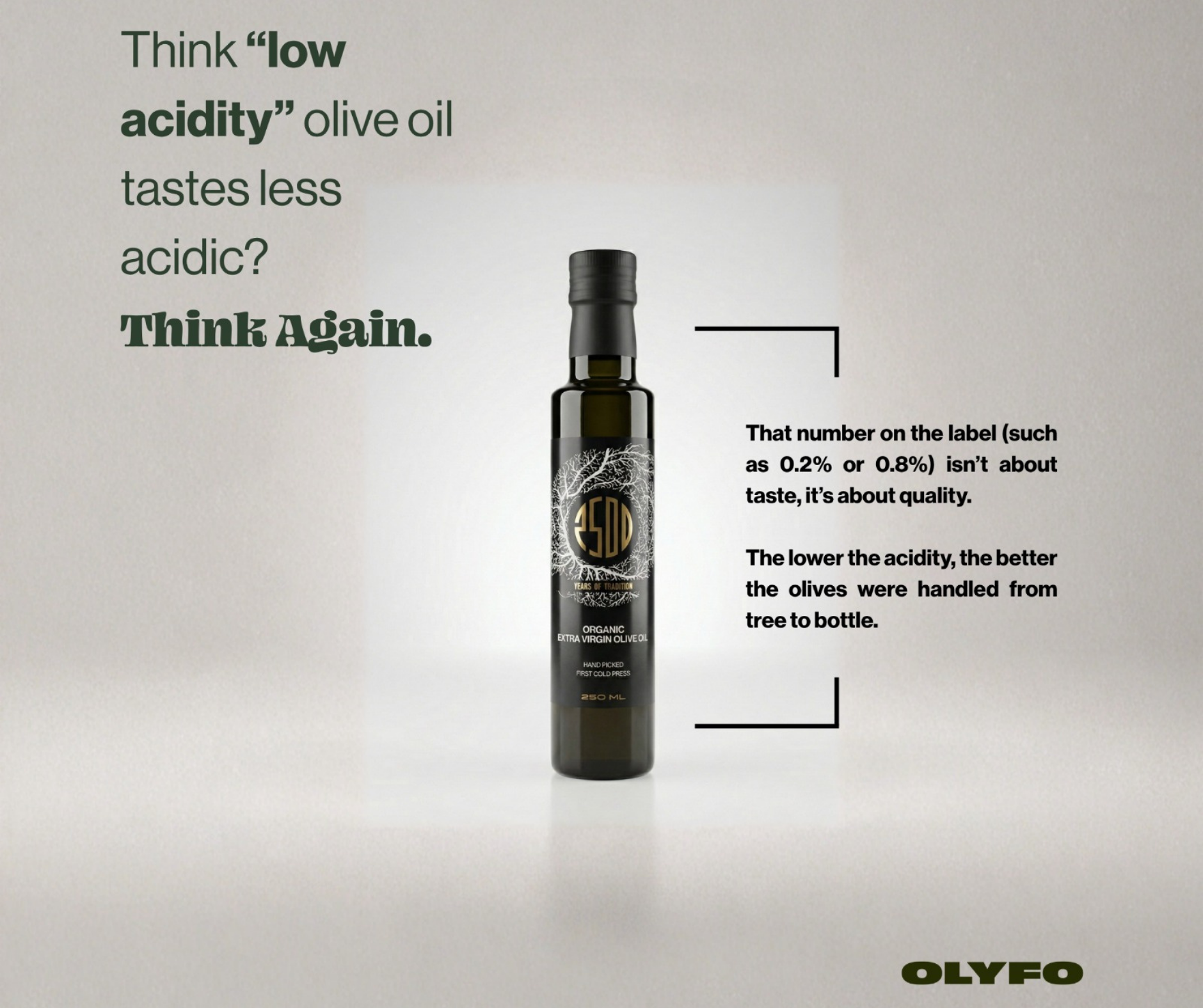
When people see “0.2% acidity” or “0.8% acidity” on an olive oil label, they often assume it refers to a sharp or sour taste. In fact, olive oil acidity does not describe flavor or pH. It refers to free acidity: the amount of free fatty acids in the oil, expressed as oleic acid, which is one of the chemical indicators used to judge how well the olives were harvested, handled, and processed.
1. Acidity Is a Quality Indicator, Not a Taste Descriptor
Free acidity rises when olives are damaged, overripe, poorly stored, or processed too slowly after harvest, because the oil’s triglycerides begin to break down into free fatty acids. That is why low acidity is generally associated with healthier fruit and better milling practices. UC Davis notes that low free fatty acidity is an indicator of sound fruit and timely processing, while international standards use it as one of the core measures of olive oil quality.
2. What the Numbers Mean on the Label
Under current IOC trade standards, extra virgin olive oil must have a free acidity of no more than 0.8 grams per 100 grams; virgin olive oil must be no more than 2.0 g/100 g; lampante virgin olive oil is above 3.3 g/100 g and/or otherwise fails required characteristics and is not sold for direct consumption; refined olive oil must be no more than 0.3 g/100 g; and olive oil blends of refined and virgin oils must be no more than 1.0 g/100 g. In other words, the number helps classify the oil, but it is only one part of the grading system.
3. Why a Very Low Number Is Good but Not the Whole Story
A low acidity reading can be a very positive sign, but it does not guarantee that an oil tastes excellent, is fresh, or is truly extra virgin by itself. Official standards also require other chemical and sensory criteria, because oxidation defects, storage damage, and flavor faults cannot be captured by acidity alone. The smartest way to read the number is this: lower acidity usually suggests better fruit condition and faster, cleaner processing, but the best olive oil is judged by the full picture chemical tests, sensory quality, freshness, packaging, and storage.