The Peppery Burn: What Bitterness and Pungency Say About an Olive Oil
🗓 21.09.26
Give a spoonful of good extra virgin olive oil to someone who has never tasted one neat, and they will often apologise for the oil. Too bitter. Too strong. It catches in the throat. Those three reactions describe, almost word for word, what a trained taster is hoping to find.
1. Where the bite comes from
Extra virgin olive oil is fruit juice, extracted mechanically and nothing else. Along with the fat, that process carries phenolic compounds out of the olive and into the oil. They are the reason a fresh oil tastes green and slightly bitter across the tongue, and the reason it can produce a peppery catch in the throat a moment after you swallow.
How much bite an oil has depends first on the fruit. On our farms in Kairouan and Zaghouan we grow both of Tunisia’s defining cultivars, and they behave differently. Chemlali is mild and fruity, with almond notes. Chétoui is bold, peppery and herbaceous. Neither is better than the other; they are two different arguments about what an olive oil should do at the table. Ripeness matters too. Olives picked earlier hold more of these compounds and give a greener, more assertive oil; later fruit gives a rounder, softer one.
This is also where the health conversation begins, and where it should stay hedged. Studies suggest that the phenolic compounds in extra virgin olive oil are responsible for much of its antioxidant activity, and they are among the reasons the oil is treated as a cornerstone of the Mediterranean diet. What is certain, and easier to verify, is that you can taste them.
2. What the tasting panel measures, and what the laboratory measures
Quality evidence for olive oil comes in two halves that are often confused with each other.
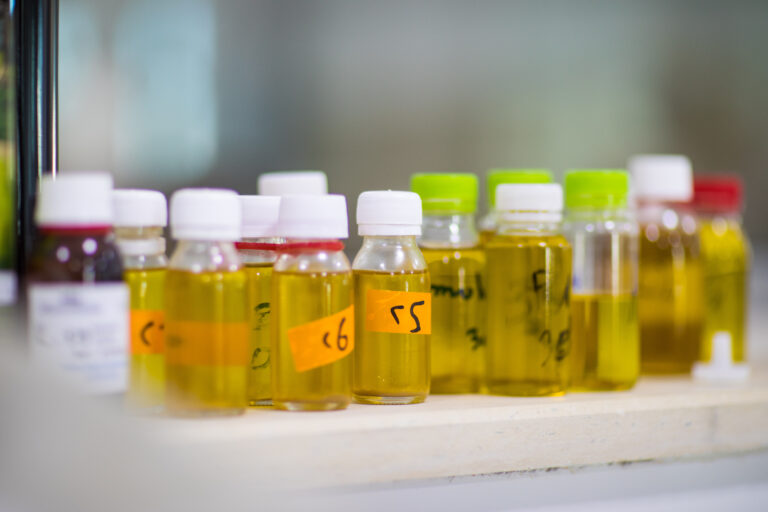
The sensory half is a formal method. Under the IOC’s approach, fruitiness, bitterness and pungency are positive attributes, assessed by a panel; faults such as rancidity, mustiness or winey notes are counted separately and disqualify an oil from the extra virgin grade. So when a shopper says an oil is “too bitter”, they are describing something the panel scores in the oil’s favour.
The chemical half measures things the tongue cannot. Free acidity is the best known: the legal ceiling for extra virgin olive oil is 0.8% (IOC), and OLYFO oils typically test at 0.5% or below — a February 2026 result came back at 0.30%, tested by certified labs. It is worth saying plainly that this figure has nothing to do with how acidic an oil tastes. A very low free acidity tells you the fruit was healthy and handled quickly. It does not promise a lively oil, and it says nothing at all about bitterness or pungency.
A buyer who reads only the chemistry knows the oil is legal. A buyer who reads both knows what will be in the bottle.
3. How an oil keeps its bite — and how it loses it
Phenolic compounds decline over time, and heat, light and oxygen speed that decline considerably. The practical rules follow from that, and they are unglamorous.
Store the bottle in a cupboard, not beside the hob and not on a sunny windowsill. Keep it closed between uses. Buy a size you will actually finish, because an opened bottle standing half empty for six months is oxidising the whole time. If an oil that once had a peppery finish has gone quiet and slightly waxy, it has aged — that is the most common reason a good oil disappoints on its second season.
Season matters as well. Our harvest begins in the fourth week of November or the first week of December, and oil from a new crop is at its most assertive when it is young. Cooking softens pungency, which is why we suggest the same thing in almost every recipe we publish: cook with the oil if you like, but keep a spoonful back and add it raw at the end. That final drizzle is where the character survives.
Bitterness and pepper are not defects to be tolerated. They are the most direct evidence a consumer has, without a laboratory, that the oil in front of them is what the label says it is.
Because in the end, quality olive oil isn’t just claimed. It’s proven.