Can You Cook With Extra Virgin Olive Oil? What Heat Actually Does
🗓 14.09.26
There is one piece of kitchen advice that survives every food trend: keep the extra virgin for salads and cook with something cheaper. It sounds sensible. It is also the reason a great many excellent bottles stay unopened while a refined oil quietly does all the work — and it is worth taking apart, because it rests on a measurement most people have never looked at closely.
1. What a smoke point is, and what it depends on
The smoke point is simply the temperature at which an oil begins to smoke visibly and break down. It is not a fixed property of “olive oil” as a category. It varies from bottle to bottle, and one of the things that moves it is free acidity — the proportion of free fatty acids in the oil, which rises when fruit is bruised, stored badly or milled late.
The International Olive Council sets the ceiling for extra virgin at 0.8% free acidity. That is the legal line, not a quality target. OLYFO oils typically test at 0.5% or below; a February 2026 result on our oil came back at 0.30%, tested by certified labs. An oil sitting near the legal ceiling and an oil at a third of it are not the same product in a hot pan, even though both may legally be called extra virgin.
Refined oils, meanwhile, advertise high smoke points for an unglamorous reason: refining removes everything that could smoke. The polyphenols, the aromatics, the pepper at the back of the throat — all stripped out. You are buying a fat with a high tolerance and nothing else in it.
2. What actually happens in your pan
Most domestic cooking is gentler than people imagine. Sautéing vegetables, softening garlic, simmering a sauce, roasting at ordinary oven temperatures — none of this is the punishing environment a deep commercial fryer represents. Studies that heat olive oil under household conditions suggest it holds up better than its reputation, and researchers generally credit its high proportion of monounsaturated fat together with its natural antioxidants.
The practical signal is the one in front of you. If the pan is smoking, it is too hot — for extra virgin olive oil, for refined oil, for any fat. Smoke is not a property of the bottle you chose; it is feedback about the heat you set. Bring the pan to a medium heat, add the food promptly rather than letting oil sit alone over a flame, and the oil spends very little time at its limit.
What you do lose to heat is aroma. The green, grassy, peppery top notes of a fresh extra virgin oil are volatile, and cooking softens them. That is a reason to plan around them, not a reason to avoid cooking with good oil altogether.
3. How to cook with it and still taste it
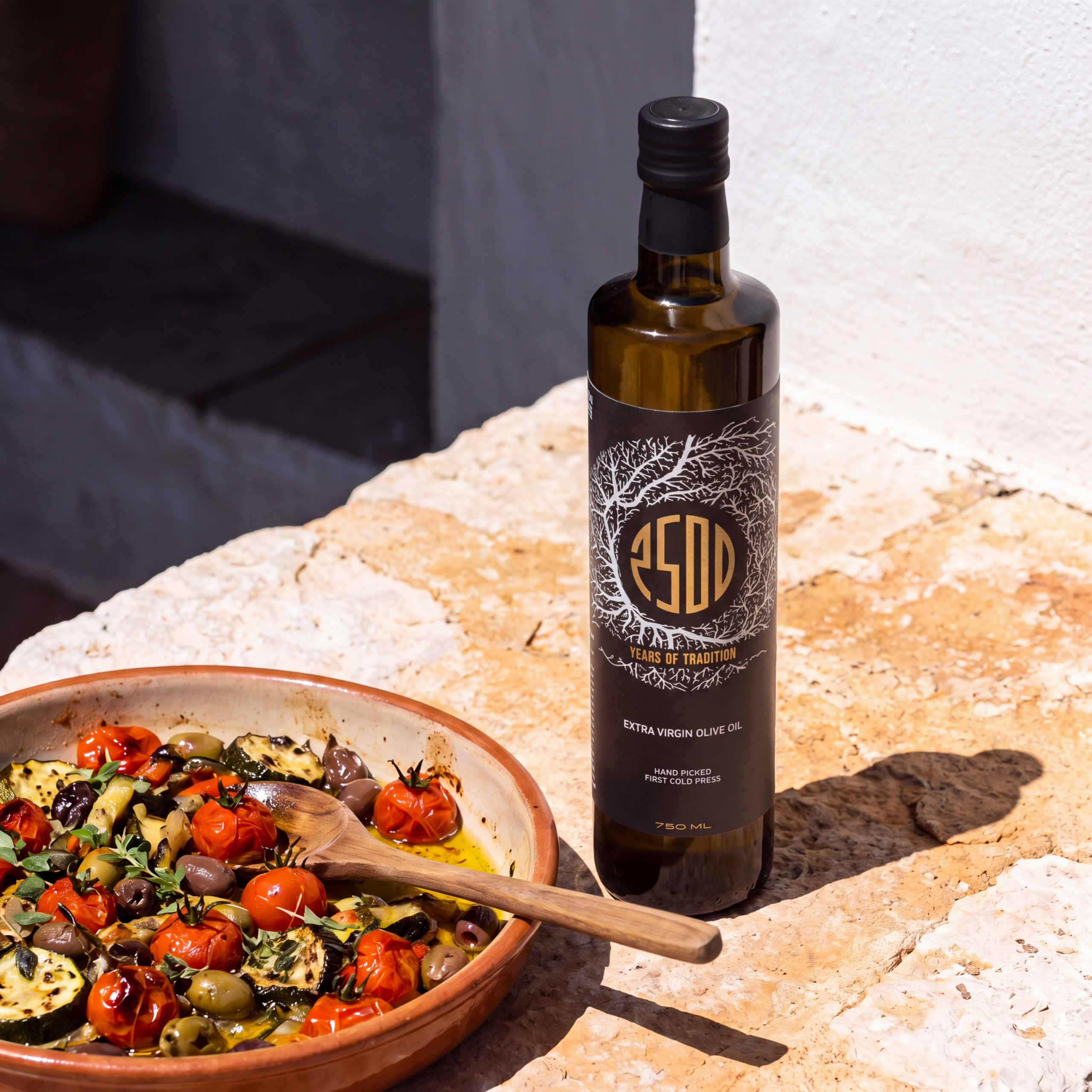
Choose an oil with something to lose. OLYFO Gold Extra Virgin Olive Oil is pressed from Chétoui and Chemlali olives grown on our farms in Kairouan and Zaghouan — Chétoui bringing the bold, peppery, herbaceous backbone, Chemlali the mild fruit and almond notes. A robust oil still reads through a tomato sauce; a thin one disappears.
Cook with most of it, finish with the rest. This is the oldest habit in a Tunisian kitchen and the most useful one: three spoons in the pan, one spoon raw over the plate at the end. You get the cooked character and the fresh aroma in the same dish.
Store it as carefully as you buy it. Cool, dark, tightly capped, and not on the shelf above the stove, where heat and light will age an oil faster than any pan ever will. For trade buyers the same rule scales up: intake specifications, warehouse temperature and shelf lighting decide how much of the mill’s work is still in the bottle when a customer opens it.
And buy on numbers as well as on taste. Harvest timing, cultivar, free acidity and how the oil has been kept tell you far more about how it will behave over heat than the word “extra virgin” on its own ever can.
OLYFO Gold Extra Virgin Olive Oil — 2500 years of tradition in every drop.
Because in the end, quality olive oil isn’t just claimed. It’s proven.