From Roman Ruins to Global Tables: Why Tunisia’s Olive Oil Legacy is Unbreakable
🗓 23.12.25
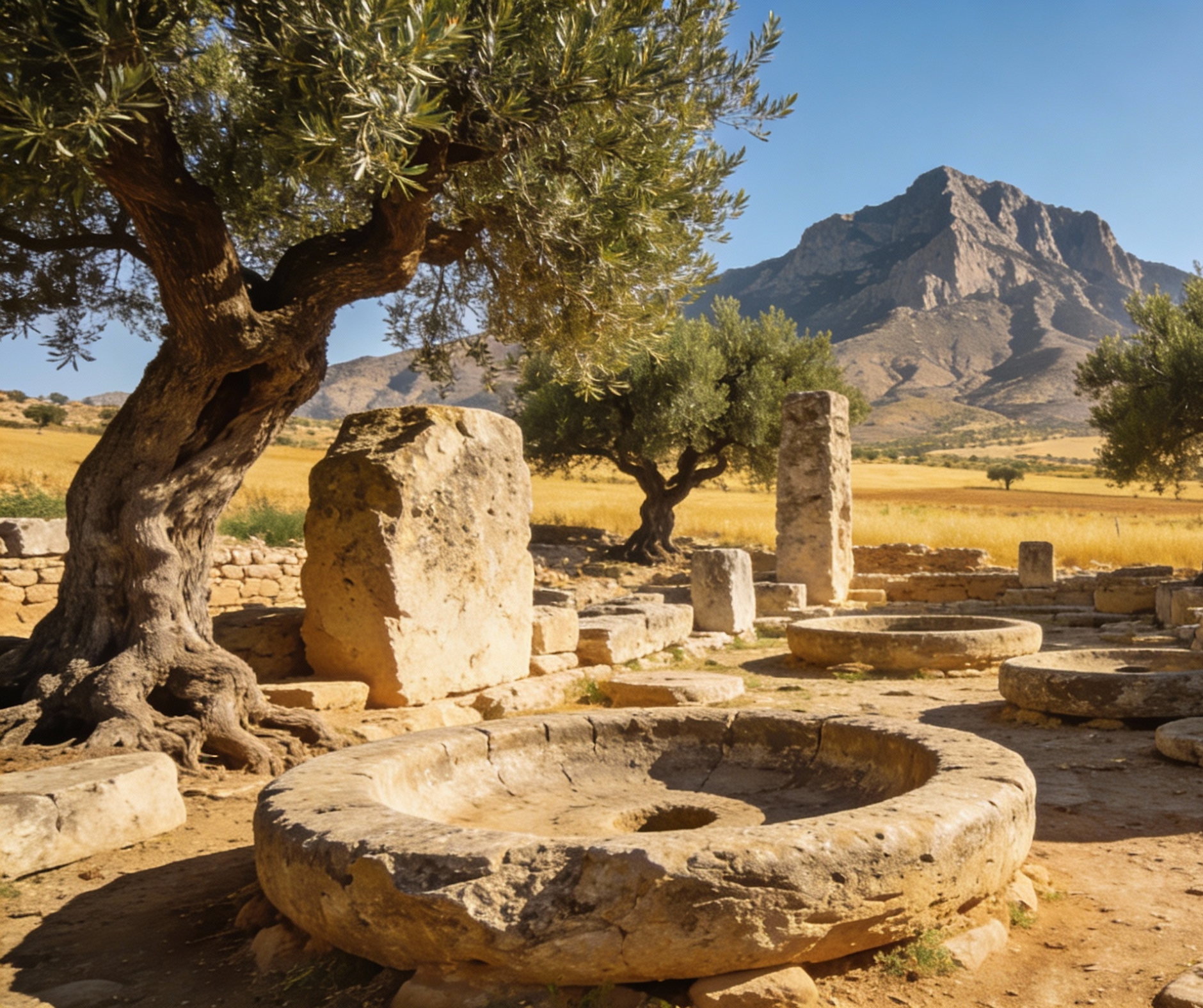
In the sun-drenched steppes of Tunisia’s Kasserine province, the earth recently gave up a secret that confirms what we at OLYFO have always known: this land was born to produce olive oil. Archaeologists at Henchir el-Begar have uncovered a massive Roman industrial complex, featuring monumental pressing machines capable of processing tons of olives daily a discovery that identifies the site as one of the largest production districts in the entire ancient Mediterranean. But for us, these stone giants are not just ruins; they are the ancestors of our modern industry. They prove that Tunisia’s status as a world-class olive oil producer isn’t a recent trend, but a 2,000-year-old dynasty rooted in the very soil we cultivate today.

Unearthing the Industrial Heart of the Roman Olive Economy
At Henchir el-Begar, researchers have brought to light an extraordinary olive oil production hub that thrived between the 3rd and 6th centuries CE, revealing that Tunisia was the “liquid gold” superpower of the ancient world a title we are reclaiming today. The Roman complex was built for sheer industrial dominance, featuring twenty massive beam pressesmonumental wooden lever machines capable of pressing 12,000–18,000 kilos of olives annually per unit, with each single pressing handling up to a ton of olives. These weren’t small village mills, but a true industrial-scale complex designed to produce far more than locals could consume, fueling a vast export network that kept the Roman Empire running and demonstrating how deeply integrated Tunisia was in the ancient agrarian economy. This ancient logistical marvel mirrors modern Tunisia’s resurgence on the global stage; just as Roman ships once carried our oil to every corner of the empire, Tunisia has recently ranked as the second-largest exporter of olive oil worldwide, supplying premium extra virgin oil to markets from New York to Tokyo. The sheer engineering scale of the beam presses reflects the importance of olive oil not only as nourishment and fuel but also as an export commodity that underpinned wealth and cross-Mediterranean trade, establishing the export-first DNA that still defines our national economy today.
Mastering the Arid Steppes: A Timeless Terroir
Perhaps the most striking continuity is the mastery of our challenging climate. The Roman estate thrived in the Jebel Semmama massif, a region where olives flourish despite limited rainfall, relying on dry-farming techniques that remain a hallmark of Tunisian agriculture. Today, we still rely on this rain-fed method, which naturally spaces trees further apart to share scarce water, stressing the olives just enough to produce the high-polyphenol content that health-conscious consumers demand. The ancient farmers of Henchir el-Begar likely cultivated resilient ancestors of our beloved Chemlali and Chetoui varieties, proving that the secret to our oil’s award-winning profile is a sustainable partnership with the arid land that has remained unchanged for millennia
A Living Tradition: How Ancient Practices Echo in Modern Tunisia
Beyond the machinery, the excavations paint a vivid picture of the human community that powers the harvest a tradition that remains the heartbeat of rural Tunisia. The ancient site included a formal marketplace authorized by the emperor himself, serving as a hub for the seasonal laborers and tenant farmers who were the engine of this industry, a dynamic that mirrors the modern Tunisian maasra (press) culture. Today, Tunisia remains one of the world’s leading olive oil producers where the harvest is not just an agricultural task but a social phenomenon and community ritual; from November through February, families and neighbors mobilize with nets and ladders to hand-pick olives, creating a festive atmosphere of shared labor that connects them with their ancestors’ seasonal rhythms. Just as the Romans understood that “real wealth came from large agricultural estates,” we continue to view our groves as the lifeblood that sustains our rural communities. Despite technological advances, traditional extraction methods persist alongside modern mills to preserve artisanal character, and Tunisia’s unique climate allows 95% of olive groves to be organically farmed a practice rooted in centuries of non-chemical cultivation that bridges ancient respect for the land with contemporary sustainability.
The Roman olive oil complex at Henchir el-Begar offers more than archaeological wonder; it reveals the deep roots of an agricultural tradition that still thrives in Tunisia today. From monumental beam presses of antiquity to hand-picked harvests and organic groves across the countryside, olive oil remains a living testament to Tunisia’s rich history and enduring cultural identity.
Original article appeared on : https://www.oliveoiltimes.com/production/archaeologists-uncover-massive-roman-olive-oil-complex-in-tunisia/142826